
Insurance companies and restoration professionals use a system known as the Category of Water Damage to classify the severity of a leak. This classification determines the safety protocols needed to protect your family and the specific cleanup methods required for your property.
Mistaking the type of water damage in your home puts your health at risk, and it can complicate the restoration process. In this guide, we explain what these contamination levels mean for your claim and how to ensure your home is restored safely.
Key takeaways:
- The category of water damage determines if you can dry materials in place or if you must tear them out to prevent disease.
- Clean water (Category 1) can degrade into dangerous black water (Category 3) in as little as 24 hours.
- Accurate classification with evidence can prevent insurers from wrongly applying a sub-limit or pushing a covered loss into an excluded category.
Water Damage Categories: What Insurance Adjusters Look For
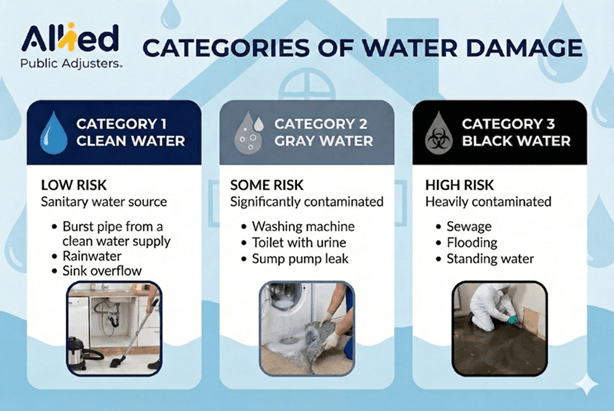
When evaluating a claim, insurance adjusters classify water damage into one of three distinct categories based on the water’s level of contamination:
- Category 1 (Clean Water): Originates from a sanitary source, such as a broken water supply line or a leaking faucet.
- Category 2 (Gray Water): Contains significant contamination and has the potential to cause illness or discomfort.
- Category 3 (Black Water): Grossly contaminated and contains pathogenic, toxigenic, or other harmful agents.
This classification dictates how the insurance company handles your claim and calculates the overall cost of restoration. More importantly, it determines the safety of your living environment. The assigned category triggers specific, mandatory cleanup protocols defined by the ANSI/IICRC S500 Standard for Professional Water Damage Restoration. Failing to follow these rules can leave dangerous pathogens behind, putting your family at risk.
How Contamination Levels Define Each Category
Insurance adjusters classify your category of water damage based on the level of contamination present before any action plan can be considered.
First, the category of water damage decides the exact scope of your repairs. Highly contaminated water requires a more thorough cleaning. Meanwhile, clean water usually requires standard drying equipment.
Second, this water damage classification creates a strict timeline for your response. Clean water can turn into dangerous wastewater quickly, so you have to act fast. For example, a standard pipe burst presents a lower risk, and a sewage backup is an immediate cleanup priority.
Ultimately, this specific label dictates how your insurance company applies policy limits and sub-limits to your claim.
Categories of Water Damage vs. Classes: What’s the Difference?
Water damage categories refer to the level of contamination in the water, whereas water damage classes refer to the required rate of evaporation for the water to dry.
The category tells us if the water is safe to touch or if it carries dangerous pathogens. The class measures absorption (how much water has soaked into the materials). It tells the restoration team how many dehumidifiers and fans are needed to dry the structure.
The category of water damage is the most critical factor for your insurance claim because it determines whether your policy covers a simple dry out or a full structural tear-out. The category also determines if the damage is covered or if specific exclusions apply.
Category 1 Water Damage (Clean Water)
Category 1 is water that originates from a sanitary source that does not pose substantial harm from inhaling, ingesting, or touching it. Clean water damage usually comes from the pipes that bring fresh water into your home.
Sources of Category 1 water damage include:
- Burst water supply lines (such as under a sink or behind a fridge).
- Overflowing bathtubs or sinks (with no contaminants).
- Rain or melting snow entering through a compromised roof or window seal. Atmospheric rainwater is classified as Category 1, but can become Category 2 or 3 if it contacts contaminants like dirt, rodent droppings, or other debris before entering your home.
- Broken toilet tanks (containing clear water only).
It depends on how soaked the materials are, but things like carpet and drywall can often be dried in place instead of being replaced because the water is clean. Many insurance policies might also cover the costs for water extraction and drying equipment.
Key Considerations for Category 1 Water Damage Claims
Once Category 1 water touches dusty floors, soil in a crawlspace, or sits for more than 24 hours, it degrades into Category 2. If you wait too long to report the claim, the insurer may argue that the escalation was due to neglect, potentially denying coverage for any additional damage.
Category 2 Water Damage (Gray Water)
Category 2 is water that contains significant contamination and has the potential to cause discomfort or sickness if contacted or consumed by humans. It can come from the soap and grime inside an appliance. Or, the water collects dirt and chemicals as it travels through your walls, floors, and insulation.
Important note: It is no longer safe for homeowners to handle without protective gear.
Sources of gray water contamination include:
- Discharge from washing machines or dishwashers (containing detergents, food grease, and soil).
- Toilet overflows containing urine (but no feces).
- Sump pump failures (carrying soil and silt).
- Leaking water beds or aquariums.
Key Considerations for Category 2 Water Damage Claims
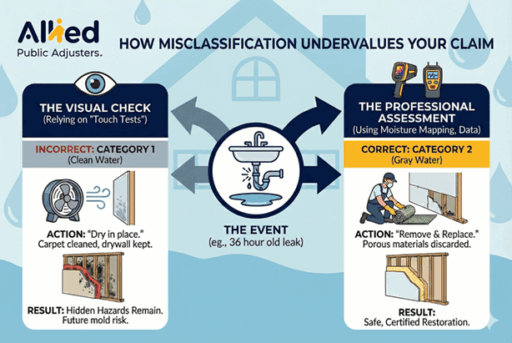
Disagreements often arise when a loss is classified as Category 1 even if contaminants are present. Category 2 repairs are more expensive due to the required demolition and disinfection. An incorrect classification can leave you with an underpaid claim and a property that hasn’t been properly sanitized.
A water damage public adjuster can ensure the classification matches the actual conditions on-site by documenting the water source and the presence of contaminants.
Category 3 Water Damage (Black Water)
Category 3 is grossly unsanitary water. It contains harmful pathogens, bacteria, and fungi that can cause severe illness upon exposure. According to Northern Arizona University researchers, this water comes from sewage or other contaminated sources.
Sources of black water contamination include:
- Sewage backups from drains or toilets. Any overflow originating beyond the toilet trap is Category 3, regardless of visible content or color.
- Rising floodwaters from rivers, streams, or seawater.
- Ground surface water entering the home.
- Any Category 1 or 2 water that has been left standing for more than 3 days.
- Water from thawed freezers containing decomposed meat, spoiled food, or other biological matter becomes Category 3 due to bacterial contamination.
Key Considerations for Category 3 Water Damage Claims
The higher costs associated with Category 3 water damage come from strict safety guidelines that require protective gear for workers and the removal of contaminated materials. If your home is affected by black water, you’ll need to remove and discard all porous materials it touches, like carpets, drywall, and upholstery, since they can’t be cleaned.
It’s also worth noting that standard homeowner policies usually don’t cover flood damage but may cover sewer backups. A common reason for claim denials is misidentifying the source of Category 3 water.
A public adjuster can help protect your insurance coverage by accurately documenting the incident as a plumbing failure instead of a weather event.

Comparing the Categories of Water Damage
Here is a quick comparison of the three categories of water damage:
| Category | Water Source | Repair Requirements | Implications for Insurance Claim |
|---|---|---|---|
| Category 1 (Clean Water) |
Broken supply lines, tub and sink overflows (no contaminants), falling rainwater. | Dry in place. Extraction and dehumidification. Materials like carpet can often be saved if dried quickly (within 24–48 hours). | Lower cost. Insurers expect a simple dry-out. If you claim extensive demolition, they may dispute it unless you can prove that the water was trapped. |
| Category 2 (Gray Water) |
Washing machine overflow, dishwasher discharge, sump pump failures. | Clean and sanitize. Carpet padding must be removed or restored with deep cleaning. Drywall may need flood cuts. | Strict sanitation. Homeowners must prove the water contained significant contaminants (like detergents or urine) to justify replacing materials rather than just drying them. |
| Category 3 (Black Water) |
Sewage backup, toilet overflow with feces, and rising flood water from outside. | Full removal. All porous materials touched by Category 3 water must be removed and discarded. | Higher cost. Insurers might cap these claims under a low “Mold” or “Bacteria” sub-limit instead of your full policy limit. Floodwater exclusions may apply. |
Understanding Category Degradation in Water Damage Claims
The longer water sits, the more dangerous the damage becomes. This degradation process makes prompt notice a strict requirement in your insurance policy.
According to the IICRC S500 Standard for professional water damage restoration process, the main factors that can worsen the damage include:
- Contact with Materials: As clean water flows through wall cavities, it picks up dust, drywall debris, and rodent waste. This immediately turns clean water into Category 2.
- Temperature: Heat speeds up the entire process. In a warm home, bacteria grow much faster and can turn the leak into black water very quickly.
Here’s how category degradation can change your coverage:
- Neglect Exclusion: Almost every homeowner’s policy includes a “Duties After Loss” clause. This is your legal obligation to take reasonable steps to protect the property from further damage. If an insurance adjuster determines that a Category 3 situation exists only because you waited a week to call for help, they can cite neglect. This means they might pay for the initial pipe repair but deny the thousands of dollars needed for mold remediation and structural tear-out.
- Fungi and Bacteria Sub-Limit: Category 1 losses are typically covered up to the policy limits. However, if the damage has escalated to Category 3, the insurer may try to classify your entire claim under this small sub-limit because bacteria are present, even if the damage was caused by a covered pipe burst.

What Homeowners Should Do After Identifying Water Damage
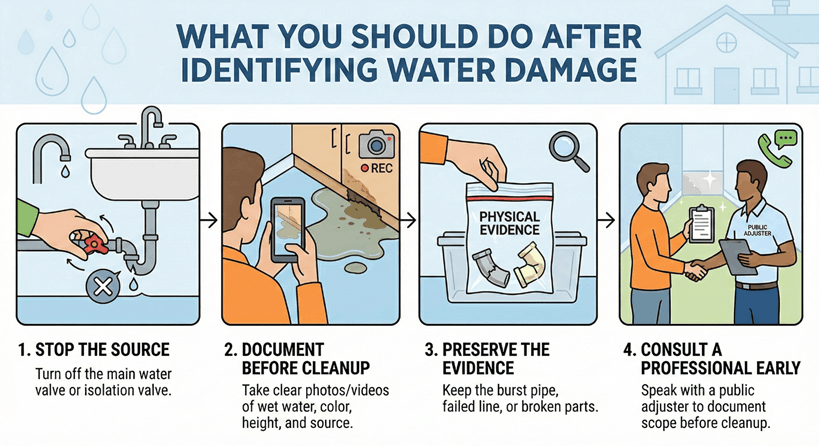
Acting quickly prevents the water from degrading into a higher contamination category and preserves the critical evidence needed to support your insurance claim.
- Stop the Source: Turn off the main water valve or the isolation valve to the appliance.
- Document Everything Before Cleanup: Take clear photos and videos of the water while it is still wet. Capture the color, the height of the water, and the source. Once the water dries, it is much harder to prove it was a Category 3 sewage backup rather than a spill.
- Preserve the Evidence: Keep the burst pipe, the failed supply line, or the cracked connector. This is your physical evidence that the loss was sudden and accidental.
- Consult a Professional Early: Speak with a water damage public adjuster before you start the cleanup. We help you document the true scope of the loss so the evidence isn’t thrown away by a cleaning crew.

Why You Must Document the Damage Immediately
Evidence of contamination, like the murky color of the water or a strong odor, can vanish within hours. If the insurance adjuster doesn’t see the severity of the water firsthand, they often won’t write an estimate for the necessary level of cleanup.
- Capture the Scene Before It Changes: Water recedes, dries, and smells dissipate. If you don’t document the sediment, color, or debris now, the insurer may default to classifying it as Category 1. This assumption lowers your payout and ignores the health risks.
- Preventing Misclassification: Clear evidence of the source helps the insurer to acknowledge the category immediately. This prevents them from downgrading a Category 3 biohazard claim to a Category 1 leak.
- Supporting the Scope of Work: Photos of the initial saturation demonstrate that the materials were non-salvageable according to industry standards, justifying the cost of the tear-out.
Common Misconceptions About Water Damage Categories
These misconceptions often lead homeowners to use the wrong cleanup methods or accept settlements that don’t cover their actual damage.
1. If the water looks clear, it’s Category 1.
This is the most dangerous myth. Water from a toilet backflow looks crystal clear sometimes but still contains millions of microscopic pathogens. If the water came from beyond the toilet trap, it is Category 3 regardless of clarity.
2. Odor alone doesn’t determine if the water is bad.
While raw sewage has a distinct smell, many dangerous pathogens and viruses are odorless. A musty smell indicates mold which is a separate issue. The absence of a smell does not prove the water is sterile.
3. It’s just a little water. I’ll clean it myself.
With Category 3 water, attempts to clean porous materials like carpets may inadvertently push bacteria deeper into the fibers. Homeowners often try to handle this themselves to save money, but in doing so, they may unknowingly trap pathogens in their living spaces, leading to potential long-term health issues. The only safe option is to use professional removal services.
4. It’s just a leak, so it’s covered.
Insurers focus heavily on the timeline of the event to distinguish between a sudden and accidental loss and long-term maintenance neglect. If an adjuster finds evidence of rot or rust during their inspection, they may argue the leak was gradual and deny the claim entirely. You must prove the damage resulted from a distinct, sudden event.
5. All flood water is the same.
There is a strict policy distinction between water backup (internal plumbing issues) and flooding (external rising water). Standard policies cover internal backups but exclude external flood events. Misidentifying the source, or allowing an insurance adjuster to label a backup as a flood, can result in an immediate denial.
How an Independent Assessment by a Public Adjuster Can Protect Your Claim
While the restoration crews are busy handling the physical cleanup, a water damage public adjuster is dedicated to making sure that your insurance claim is financially accurate.
We take the time to perform an independent evaluation, ensuring that the scope of work reflects the extent of the damage you’ve experienced, instead of just what the insurance company is willing to cover.
Validating Moisture Levels
Restoration companies sometimes miss hidden pockets of moisture, or they may be pressured by insurers to dry in place when materials should actually be removed. A public adjuster can audit the restoration process by using infrared cameras and hygrometers to create a complete moisture map of your property.
This data provides the evidence needed to prove that water is trapped in structural cavities, which requires professional removal rather than just surface-level drying.
Ensuring Compliance with Safety Standards
Insurance estimates may omit necessary demolition to save costs. A public adjuster audits the insurer’s scope of work against the IICRC S500, which recommends that porous materials cannot be saved if saturated with Category 2 or 3 water.
Documenting and validating these findings prevents the insurer from incorrectly categorizing materials that should be discarded for your safety.
Distinguishing Sudden Damage from Wear and Tear
Insurers may deny claims by attributing damage to gradual seepage or maintenance neglect. An independent assessment by a plumbing insurance claims public adjuster documents the sudden nature of the failure, such as a clean pipe break versus long-term corrosion. This forensic evidence can help to overturn wrongful denials.
How AlliedPA Helps You Navigate Water Damage Claims
Navigating water damage categories is a technical process where small details dictate the outcome of your entire claim. If you find yourself uncertain about the source of the water or the extent of the contamination, consulting a public adjuster can provide the clarity needed to protect your home and your health.
Partnering with Allied Public Adjusters helps to turn complex, technical water damage claims into a manageable process. While insurance adjusters focus on their company’s internal guidelines, our team of experts is dedicated to ensuring your claim adheres to industry-standard restoration protocols.
First, we check your policy. We compare the physical signs of damage against the rules in your insurance policy. This also involves providing an objective record of the damage to prevent misclassification.
Finally, we secure the settlement. We use the correct water damage category to push for a fair offer and make sure the payment reflects the real cost of a complete and safe recovery.
If you’re struggling with a denied or underpaid claim, or if the process is overwhelming, the most important step you can take is to understand your rights. AlliedPA is here to help you secure the settlement you deserve.
We provide expert support for water damage and plumbing claims across California and beyond.
Get Expert Support on Water Damage Claims Today
FAQs
What are the categories of water damage?
The three categories of water damage are defined based on contamination levels. Category 1 is clean water from a sanitary source. Category 2 is grey water that contains contamination. Category 3 is black water, which is contaminated and poses severe health risks.
What is the difference between the water damage category and class?
Water damage category refers to the level of contamination in the water. On the other hand, water damage class refers to the amount of water and the rate of evaporation required to dry it.
How quickly can water damage change categories?
Water quality degrades rapidly. Clean water can deteriorate into grey or black water in as little as 24 to 48 hours. High temperatures and soil contact make this happen faster.
What is category 3 water damage?
Category 3 water is known as black water. It can cause serious sickness or death. Examples include sewage backups, rising floodwaters from rivers, and wind-driven rain from storms.
Is category 3 water damage dangerous?
Yes. Category 3 water carries pathogens, bacteria, and toxic chemicals. Direct contact or inhalation of mist from this water will harm you. Therefore, full protective gear and removal of absorbent materials are necessary for professional cleanup.
Why does the water damage category matter for insurance?
The category dictates the “Scope of Work” your insurer will pay for. A Category 1 loss might only be approved for drying. A Category 3 loss requires the removal and replacement of materials. Misclassification can lead to a settlement that does not cover the necessary repairs.
Can category 1 water damage turn into category 3?
Yes. If clean water is left stagnant, it will eventually support bacterial growth. Contact with contaminants like animal waste or soil also degrades the quality immediately. We recommend prompt documentation to prove the timeline of the loss.
How do insurers determine the water damage category?
Insurers typically assess the source of the water and the time elapsed since the leak began. We ensure that objective data, like moisture mapping, is used to validate the true severity of the loss.
Is category 3 water damage covered by insurance?
Coverage depends on the source. Sewage backup coverage is usually separate and has limits. Rising floodwater is typically not covered unless you have flood insurance. We will review your policy details to help you understand your coverage limits.