

Water damage is often a silent crisis, compromising your home’s structural integrity long before visible signs appear. Subtle warning signs like a sudden spike in your utility bill, a lingering musty odor, or an unexplained ceiling spot can signal extensive hidden destruction.
Left unchecked, this seemingly small leak can lead to structural failure, mold growth, and a complex, underpaid claim dispute with your insurer. The most important step in preserving your property and your financial recovery is understanding how to detect a water leak early. This expert guide provides a systematic method for identifying water intrusion in difficult, concealed areas like walls, slabs, and roofs.
Key Takeaways
- Early leak detection can prevent severe water damage and financial loss.
- Use your water meter, sound cues, and infrared tools to find hidden leaks.
- Professional public adjusters help maximize insurance recovery for water-related damage.
- Document and report leaks promptly to support your insurance claim.
- AlliedPA provides expert plumbing and water damage claim services in California.
Why Detecting a Water Leak Early Matters
Hidden water leaks in your house can silently compromise your home’s structural integrity and lead to mold growth long before a stain appears. For homeowners in California, Arizona, Nevada, and Washington, identifying these risks early is essential to mitigating loss and protecting the value of your property claim.
The Real Cost of Unnoticed Leaks
The financial impact of a water leak extends far beyond a high utility bill. Industry data indicates that a single slow drip can waste up to 10,000 gallons of water annually, but the true cost lies in the hidden destruction of your property.
Long-term moisture exposure silently undermines foundations, fuels mold growth, and compromises electrical systems, creating severe safety risks. In regions like California, where seismic activity can shift plumbing lines, these leaks often cause extensive structural damage before they are ever detected, turning a minor maintenance issue into a complex insurance claim.
Common Property Areas Prone to Water Leaks
Water damage rarely occurs in plain sight. It typically originates in concealed areas where detection is difficult without professional inspection.
- Walls and Plumbing Lines: Supply lines behind drywall can fail due to age (not typically covered by insurance policies) or pressure fluctuations. These leaks can saturate insulation and framing long before visible signs appear on the surface.
- Roofs and Attics: Compromised flashing or broken shingles, particularly following intense rain events, can allow water to penetrate the building envelope, damaging ceilings and insulation.
- Slab Leaks: Corrosion in underground piping (which also isn’t always covered by insurance policies) poses a severe risk to your home’s structural stability. These slab leaks can erode the soil beneath the foundation, leading to costly settling and cracking.
- High-Risk Zones: Kitchens, bathrooms, and basements are common sites of failure due to worn fittings and high usage.
Signs You Might Have a Hidden Water Leak
Recognizing the subtle indicators of a leak is critical to mitigating loss and preventing extensive structural damage before it spreads. Ignoring these early warning signs often leads to failures that complicate your recovery and your insurance claim.
Visible Water Stains or Mold Growth
Discoloration on your walls or ceilings is often the first piece of tangible evidence in a water damage claim. Brown or yellow rings typically indicate active leakage, while black or green spots signal the presence of mold in a damp environment. Because mold growth compromises indoor air quality and destroys porous materials, identifying and documenting this damage immediately is critical to proving the extent of the loss.
Sudden Spikes in Water Bills
A sudden, unexplained increase in your utility costs is a primary red flag for a concealed leak. When usage habits haven’t changed, this financial discrepancy can be a signal that a supply line may have failed behind a wall or, more critically, beneath your foundation. Reviewing past statements against current usage provides the necessary documentation to justify a professional inspection.
Damp or Musty Smells
A lingering, musty odor in enclosed spaces like basements or cabinetry is an easy tell-tale sign of trapped moisture. This smell typically indicates that a leak has been active long enough to saturate materials and foster mold growth behind the drywall. Detecting this early helps identify “hidden damages” that adjusters might otherwise overlook during an initial walkthrough.
Cracks or Bubbling Paint
Bubbling, peeling paint, or warping drywall are signs of material saturation. When water intrudes, it breaks down the bond between the paint and the surface. More severely, unexplained cracks in flooring or walls can indicate a slab leak, where escaping water erodes the soil beneath your home, compromising the structural integrity of the foundation.
Step-by-Step Guide: How to Find a Water Leak in Your House
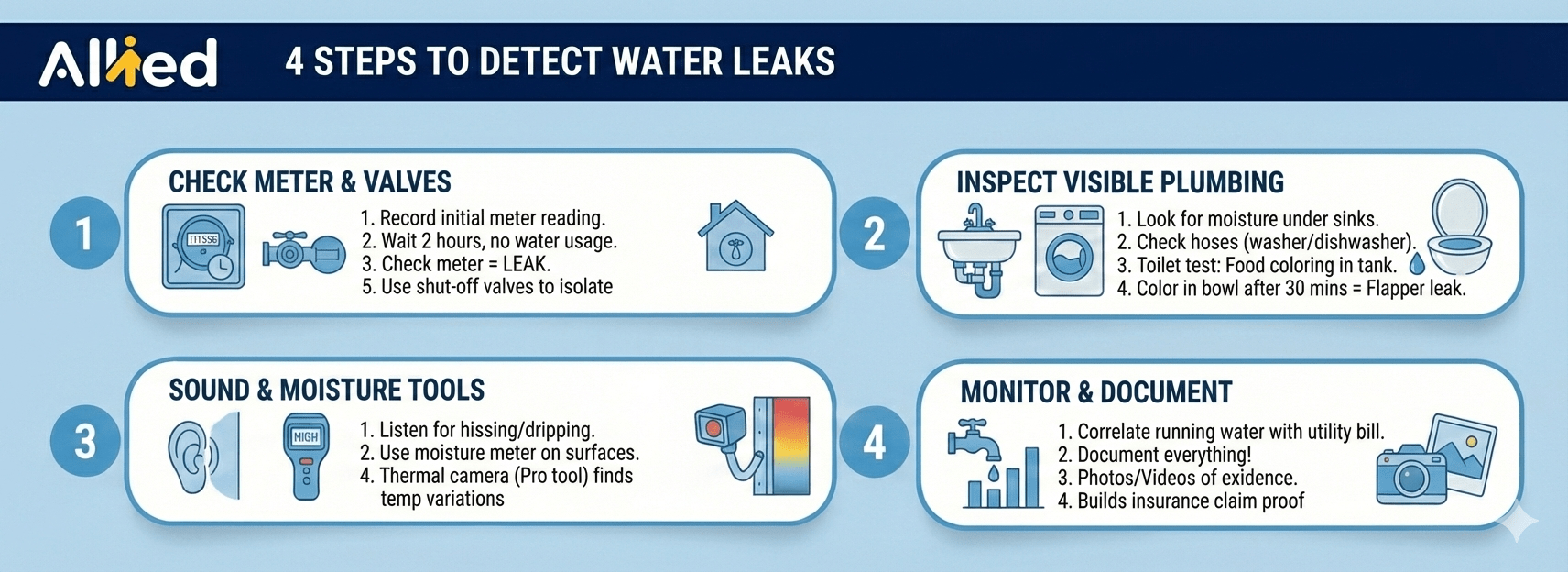

Locating the source of a water leak in your house requires a systematic, non-invasive approach to identify the origin without causing unnecessary destruction. By following this structured process, you can verify the leak and gather critical initial evidence before professional remediation begins.
Step 1: Check Water Meter and Shut-Off Valves
- Begin your investigation by verifying the water meter and main shut-off valves. You will need to establish a baseline reading at the meter (what are the current numbers). This is typically located in a ground box near the street or inside the basement.
- Ensure all faucets and water-using appliances are turned off, then record the exact meter reading.
- After waiting two hours without water usage, check the reading again.
- Any movement confirms an active leak within the system.
- If confirmed, use isolation shut-off valves (under sinks or on the main line) to narrow down the location of the loss.
Step 2: Inspect Visible Plumbing and Fixtures
- Conduct a systematic inspection of accessible plumbing.
- Check for moisture under sinks and inspect supply hoses on washing machines and dishwashers for signs of wear.
- For toilets, perform a simple diagnostic test: add a few drops of food coloring to the tank and wait 30 minutes without flushing.
- If color seeps into the bowl, the flapper is compromised.
- Identifying these sources early allows you to distinguish between sudden damage and long-term maintenance issues (which may be excluded by your insurance policy).
Step 3: Use Sound and Moisture Detection Tools
- If visible checks yield no results, rely on sensory and technical tools.
- Listen for the sound of hissing or dripping behind walls in quiet rooms.
- If possible, use a moisture meter to scan surfaces (which can be purchased by most big box stores); high readings indicate water is concealed behind the drywall.
- Thermal imaging cameras, a specialized tool for professionals, can detect temperature variations from evaporation to pinpoint leaks non-invasively.
Step 4: Monitor for Continuous Running Water and Document
- If you hear water running when no appliances are active, you may have a pressurized pipe failure.
- Correlate this with your utility bill monitoring to confirm the volume of loss.
- Most importantly, document every finding.
- Take clear photos and videos of the meter readings, moisture spots, and any source of water you discover.
- This concurrent documentation builds the burden of proof required to support your insurance claim later.
How to Detect Evidence of Water Leaks in Concealed Spaces
Detecting leaks in concealed areas requires specific techniques to uncover damage that is not immediately visible to the naked eye. Identifying these issues early is critical to halting structural decay and documenting the full scope of the loss for your insurance claim.
How to Find a Water Leak in a Wall Without Breaking Drywall
Locating a concealed leak requires a forensic approach that preserves the integrity of the wall until the full scope of the loss can be assessed. Follow these steps for non-invasive detection:
- Visual and Smell Test Examination: Begin with a systematic check for cool, damp sections of the wall and subtle signs of material saturation like bubbles, peeling paint, or stains. Pay attention to any musty odors, which are evidence of moisture intrusion.
- Moisture Mapping: Utilize a moisture meter to scan the entire surface from floor to ceiling. High, localized readings provide crucial forensic evidence of a concealed leak without the need for destructive testing.
- Acoustic Detection: In silent rooms, listen carefully for the soft sound of dripping or persistent hissing, which indicates water under pressure within the wall cavity.
- Crucial Mitigation Step: Even with strong suspicion, do not cut the drywall without the help of a professional. Unnecessary demolition can exacerbate the damage and complicate the scope of the loss. Contact a professional to confirm the exact source before any destructive remediation.
How to Find a Water Leak Under a Slab
Leaks that occur beneath the concrete foundation (slab leaks) are among the most difficult and destructive types of concealed damage. Symptoms of compromised slab integrity include hot spots on the floor (indicating a pressurized hot water line failure), cracking tiles, or unexplained moisture.
While a simple meter test can confirm the presence of the leak, professionals use specialized forensic testing to pinpoint the source without extensive excavation. Experts rely on acoustic detectors and pressurized testing to locate the failure point. Dramatically high utility bills and low water pressure serve as essential early evidence for your claim documentation.
How to Find a Water Leak in Your Roof or Ceiling
The roof is the property’s primary defense, and locating a breach requires a systematic inspection of the building envelope.
- Internal Inspection: Begin in the attic, checking the ceiling, rafters, and insulation for signs of staining or dampness. Wet insulation and compromised rafters are tangible evidence that the water has successfully breached the roof system.
- External Inspection: Focus on high-risk points of entry: damaged shingles, failing chimney flashing, and compromised vents. After rain, actively monitor these areas for fresh drips to pinpoint the source.
- Forensic Detection: For concealed leaks, thermal imaging detects temperature variations caused by trapped moisture paths, allowing professionals to map the extent of the water intrusion without causing further destruction.
Professional Water Leak Detection and Restoration
While initial DIY detection is vital for documentation, complex issues like concealed wall or slab leaks require forensic expertise and specialized tools. These professional services are essential for accurate location, damage mitigation, and supporting a successful insurance claim.
When to Transition from DIY to a Professional
If initial documentation confirms a leak but the source remains concealed, relying on professional forensic expertise becomes essential. Professionals utilize advanced, non-destructive tools like thermal imaging and endoscopic cameras for precise detection, avoiding unnecessary demolition. This specialized approach ensures the leak is located accurately and the property’s structural integrity is preserved, which is vital for complex claims.
How Public Adjusters Maximize Your Water Damage Claim
Public adjusters advocate for you in negotiating with insurers to help secure a fair settlement based on your policy coverage. They manage the entire claims process, conducting forensic damage assessments to uncover every layer of hidden water loss, including moisture and structural damage. This documentation is critical because the burden of proof for the loss falls entirely on the policyholder.
Allied PA leverages an integrated in-house team of policy experts and construction estimators to build a stronger, evidence-based case. Our expert plumbing insurance claims public adjuster helps maximize your claim for complex plumbing and structural failure repairs. We also review claim denials and work towards reversing underpaid or denied cases to restore momentum toward a fair recovery.
Allied PA’s Systematic Process for Water Damage Claims
At Allied PA, we initiate the claim with a forensic damage assessment of your property loss. Our goal is to uncover every layer of hidden water and structural damage that may otherwise be missed.
- Team-Based Documentation: Our integrated in-house team documents all evidence with precision. We manage the complex valuation process, collaborating with experts to build a stronger, evidence-based case.
- Advocacy & Negotiation: We negotiate with your insurer to help maximize your claim recovery. We work towards securing the full, fair settlement owed under your policy.
Serving California, Arizona, Nevada, and Washington, we focus on providing expert claim services for all complex water-related issues.
Preventing Future Water Leaks
Proactive maintenance is the most effective strategy for mitigating risk and preserving your home’s structural integrity. By addressing vulnerabilities now, you work towards avoiding complex and costly insurance claims services.
Smart Water Monitoring Devices and Sensors
Installing smart sensors provides continuous, app-based monitoring for unusual moisture or flow anomalies. These devices can automatically shut off the main water line, significantly reducing the scope of loss and mitigating extensive structural damage when a leak occurs. This proactive step helps preserve property value and simplifies the claims process by limiting the duration of water intrusion.
Regular Maintenance Checklist for Homeowners
Implementing a proactive maintenance plan is essential for mitigating risk and preserving the structural integrity of your property. We recommend the following checklist:
| Maintenance Item | Frequency / Action | Risk Mitigation |
|---|---|---|
| Pipes, Fittings, Fixtures | Systematically inspect accessible areas quarterly. | Identify early signs of wear; mitigate future claim risk. |
| Gutters and Downspouts | Clean regularly to ensure proper drainage. | Works towards preventing water from breaching the roof and foundation perimeter. |
| Water Pressure | Test annually to maintain proper pressure levels. | Helps preserve the integrity of your entire plumbing system and reduces the likelihood of catastrophic pipe failure. |
| Appliance Supply Hoses | Proactively replace old, worn supply hoses (washers, refrigerators). | Significantly reduce the scope of loss from sudden, high-volume bursts. |
| Professional Inspections | Schedule plumbing and roof inspections for older homes. | Uncover hidden vulnerabilities and address issues before they cause catastrophic structural damage. |
Early Reporting and Documentation for Insurance Coverage
Immediate action after a water loss is essential for meeting policy obligations and strengthening your claim. Thorough documentation is the foundation of a successful claim.
- Promptly report the loss to your insurance provider or agent as soon as possible to start the claims process.
- Secure the premises and take reasonable steps to prevent further damage, such as covering exposed areas or making temporary repairs. Keep all receipts for these mitigation costs, as they are usually reimbursable.
- Document everything carefully by taking photos and videos from multiple angles, listing every damaged item, its age, and replacement value.
This immediate action strengthens your coverage case and helps address complex policy questions, such as whether a slab leak is covered by insurance.
Need Expert Advocacy for Your Water Leak Claim? Contact Allied PA
If you are struggling with a denied or underpaid claim, or if the process is simply overwhelming, the most important step you can take is to understand your rights. Allied PA is here to support you and work with you to secure the settlement you deserve.
We provide expert support for plumbing or slab leak claims across California and beyond.
Get Expert Support on Plumbing or Slab Leak Claims Today.
Frequently Asked Questions
Can a public adjuster help with water damage insurance claims?
Yes. A public adjuster advocates only for the policyholder, helping to secure a fair settlement. They conduct forensic damage assessments to uncover every layer of hidden water damage and manage the complex documentation required for water-related losses.
What should I do first if I suspect a hidden water leak?
The priority is to ensure safety and secure the premises. Immediately report the loss to your insurer and obtain a claim number. Then, take reasonable steps to prevent further damage, such as covering exposed areas, and keep all receipts for these costs.
How long does it take to fix a water leak?
The time required for repair varies widely based on the leak’s complexity. While the physical repair itself may be quick, the full recovery timeline for extensive claims, including drying, remediation, and final settlement, is often a process of long duration. A public adjuster’s comprehensive preparation helps speed up the path to a complete and fair settlement.
Are slab leaks covered by insurance?
Coverage depends entirely on your specific policy. While policies typically cover sudden and accidental damage, they often exclude damage arising from long-term deterioration or lack of maintenance. A public adjuster can review your policy to unlock every source of coverage and advocate for maximum recovery.
How do I document a water leak for insurance purposes?
Thorough documentation is the foundation of a successful claim. Document everything with photos and videos before cleanup begins. Keep a claim journal to record all communications with the insurer.
What should I do if I find a slab leak under my home?
After securing the area and reporting the loss, contact a public adjuster immediately. They will coordinate a forensic damage assessment to confirm the leak’s origin and scope, which is essential before any destructive excavation begins.
Does homeowners’ insurance cover water leak damage?
Homeowners insurance typically covers damage from sudden and accidental events (like a burst pipe) but often excludes water damage from floods (which requires separate coverage) or damage resulting from long-term maintenance issues. A public adjuster helps ensure that your claim is maximized based on your policy.
How do professionals find hidden water leaks in a house?
Professionals use advanced, non-destructive tools like thermal imaging and acoustic detectors to locate concealed leaks without unnecessary demolition. This contrasts with adjusters who often process claims quickly, which can make it easy for certain damages to go unnoticed.